Different regions, different tobacco consumption trajectories
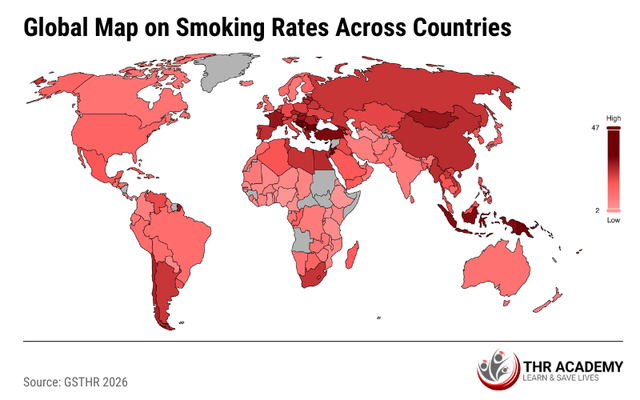
Global smoking trends differ sharply by region. Although smoking prevalence has declined in many high-income countries, the total number of people who smoke worldwide continues to increase, largely due to population growth and slower progress in LMICs [^1], [^2].
In high-income countries, particularly in Western Europe, North America, and Australia, smoking rates have fallen steadily since the 1970s following strong tobacco control measures such as taxation, advertising bans, and smoke-free laws. However, recent declines have slowed, indicating that a substantial group of people who smoke remains unable or unwilling to quit.
In LMICs, progress has been uneven. South and Southeast Asia continue to carry a heavy burden due to widespread cigarette smoking and the use of bidis, kreteks, and smokeless tobacco. In sub-Saharan Africa, prevalence remains relatively low, but rapid population growth is driving an increase in the number of people who smoke, raising concern about future disease burden.
Latin America shows mixed progress, with substantial declines in some countries alongside slower change in others. Meanwhile, Eastern Europe and parts of Central Asia, which include many middle-income countries, continue to report some of the highest smoking rates in the world, particularly among men.
Overall, tobacco use is declining in some regions, stagnating in others, and increasing in several LMIC settings. These divergent trajectories help explain why tobacco remains a major public health and development challenge and why additional approaches, including tobacco harm reduction, are increasingly part of the global discussion.
-
Dai X, Gakidou E, Lopez AD. Evolution of the global smoking epidemic over the past half century: strengthening the evidence base for policy action. Tob Control. 2022 Mar;31(2):129-137.
- Increasing Number of Smokers Worldwide