Limitations of abstinence-only approaches in LMICs
In many LMICs, tobacco control efforts have historically prioritised complete abstinence from all forms of tobacco use. While this approach is rooted in the goal of achieving a smoke-free society, it often overlooks the realities faced by people who smoke in resource-limited settings.
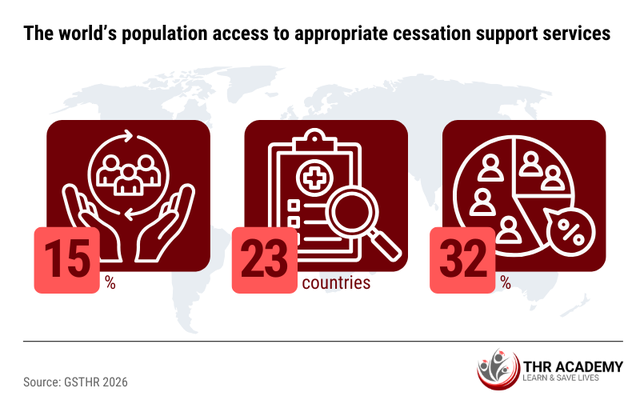
Access to cessation support and nicotine replacement therapy (NRT) is limited globally, particularly in LMICs. Only about 15% of the world’s population has access to appropriate cessation support services, and just 23 countries offer comprehensive services with cost coverage for NRT or quitlines, together covering approximately 32% of the global population [^1]. In most LMICs, the vast majority of people who smoke who attempt to quit do so without any formal support. Pharmaceutical cessation products such as nicotine patches, gums, and inhalers are often unaffordable, and their inclusion on national essential medicines lists is inconsistent. Recent evidence confirms that cessation medications are unavailable in many LMICs and unaffordable in most settings where they are available, leaving millions of people who smoke who wish to quit without effective tools or structured support [^2].
Moreover, abstinence-only models tend to ignore barriers that make quitting difficult in LMIC contexts. Many individuals live in environments characterised by high stress, unemployment, and limited access to healthcare - all factors that sustain smoking behaviour. In addition, cultural stigma surrounding nicotine use, combined with misinformation about harm reduction, discourages people from seeking help.
Without accessible cessation aids or alternative options, people who smoke may continue using combustible cigarettes despite being aware of the risks. The lack of flexible, evidence-based strategies that meet people where they are represents a missed opportunity to reduce harm at scale.
By rejecting harm reduction as a complementary strategy, abstinence-only approaches risk widening existing health inequalities. Those who can afford cessation therapies or access international markets for safer products are more likely to benefit, while disadvantaged groups remain trapped in cycles of high-risk tobacco use. Introducing proportionate harm reduction policies, such as enabling access to regulated non-combustible nicotine products, could bridge this gap.
In LMICs, where health systems face competing priorities and constrained budgets, harm reduction offers a practical, low cost and ethical means to accelerate declines in smoking-related disease and death.
-
Shankar A, Parascandola M, Sakthivel P, Kaur J, Saini D, Jayaraj NP. Advancing Tobacco Cessation in LMICs. Curr Oncol. 2022 Nov 23;29(12):9117-9124.
-
Rigotti NA, Walker N, Amer Nordin AS. Integrating Pharmacotherapy into Tobacco Control in Low- and Middle-Income Countries - A Critical Need. N Engl J Med. 2025 Sep 18;393(11):1041-1044.